

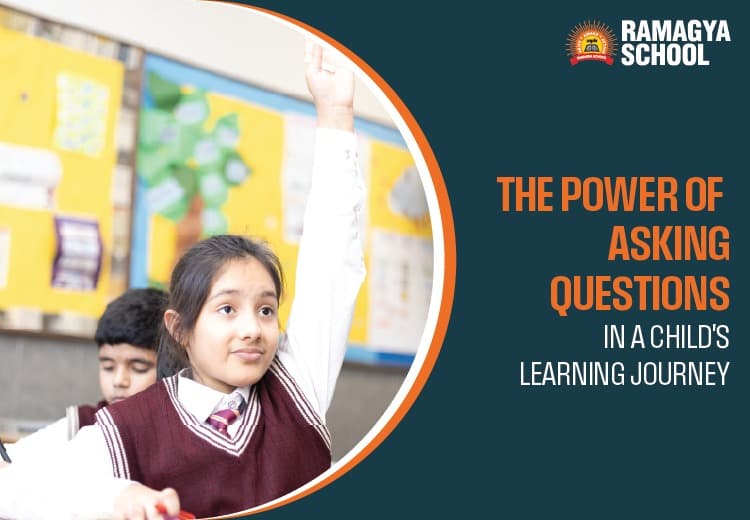
The Power of Asking Questions in a Child’s Learning Journey
Have you ever noticed how children ask the smallest yet most beautiful questions?
“Why is the moon following us?”
“Why do birds fly?”
“Why do we go to school?”
“Why does this happen?”
Sometimes, these questions make parents smile. Sometimes, they come at the busiest time of the day. But behind every little “why” is a child trying to understand the world.
A child’s question is never small. It shows curiosity. It shows thinking. It shows that the child is not just listening, but also wondering. When children feel free to ask questions, they slowly become better learners, better thinkers, and more confident speakers.
This is why asking should always be encouraged in a child’s learning journey.
Also Read: How Can Teachers Help Students Improve Weak Areas of Students?
Why Questions Matter in Learning
Questions are the first step in real learning. When a child asks questions it’s a sign that their mind is active. It is a way for them to make connections between what they are seeing with what they already know.
A child who asks questions is not troubling anyone. They are trying to understand better. They want reasons, answers, and meaning.
Children can benefit from questions:
- Make better decisions
- Learn lessons in a clear and concise manner
- Build curiosity
- Enhance confidence
- Do not be afraid to speak.
- Learn from your mistakes
- Get new ideas
- Learn to be independent
When children only memorise, they may forget later. But when they understand through questions, the learning stays with them for a longer time.
Questions Build Confidence
A lot of children are shy when they are in class. They might know something, but they still stay silent. They might have doubts but are hesitant to express their opinion.
When children are encouraged by their parents to ask questions, they start to realize that their voice is valued. They realize that they can ask questions. It is okay to learn slowly. It’s fine to take your time learning.
This increases confidence. Gradually, children become willing to participate in class discussions, group projects, stage shows and everyday conversations.
A child who asks today becomes a child who speaks with confidence tomorrow.
Questions Make Learning Fun
Learning is more fun for children when they are supported to experiment. An elementary lesson can be interesting when children begin to ask “why”, “how”, and “what if”.
For example, a science lesson about plants becomes more fun when a child asks why leaves are green. A maths lesson becomes more meaningful when a child asks where we use numbers in real life. A story becomes more interesting when a child asks why a character behaved in a certain way.
Questions turn learning into discovery. They make the classroom feel alive.
Teachers Play a Big Role
Teachers make sure that children feel safe when they are learning. A good teacher will answer each question with respect. They don’t make children feel embarrassed by asking. They help the child find an answer using a simple method.
Sometimes, teachers don’t provide the answer immediately. They may ask a question to help the child to think. This is a wonderful method to teach because children can now answer questions by themselves.
When teachers ask questions, students become curious, courageous and engaged in class.
Parents Can Encourage Asking Questions at Home
The habit of asking questions isn’t just something that happens in school. It can also be developed at home.
Parents can help by observing their children with interest. Even if the question seems simple, the child needs to feel heard. Small answers can help them feel appreciated.
Parents can tell their children:
- “That is a good question.”
- “What do you think?”
- “Let us find out together.”
- “I like the way you are thinking.”
- “Can you please explain the reason why you feel this way?”
Simple words like these give children the confidence to speak up. They are taught that their thoughts are valuable.
If teachers and parents encourage curiosity, children are more confident when they are learning.
Questions Help Children Think Better
When children are asked questions they are taught to think in depth. They don’t just accept everything without being able to understand. They try to find the reason behind things.
This habit can help them in academics and throughout their lives.
A child who is curious can resolve problems faster. They make better decisions.They can see the people and situations better. They then see the problem and consider, “How can I solve this?”
This is the way that questions develop intelligent thinking.
Learning Beyond Books
The importance of books is obvious, but learning is more than books. Kids also gain knowledge from people, nature, stories, games, travel, things, and everyday life.
A curious child can be taught from any place. They can learn by watching the rain fall, working in the kitchen or playing with blocks, going to the park, or conversing with grandparents.
When children ask, every place becomes a classroom. Every moment becomes a chance to learn something new. This type of education helps children become more aware and connected to the world around them.
Questions Make Children Future-Ready
The world is changing very fast. Children need more than answers. They need the ability to think, understand, solve, create, and communicate.
Questions help children build these skills.
A child who is encouraged to ask is more comfortable in sharing ideas. They feel comfortable in the process of learning new things. They are not afraid of making mistakes as much since they understand that any question could lead to a greater understanding.
That’s why asking questions is a crucial life skill.
A Beautiful Part of Growing Up
Every child has a lot of questions in their hearts. Some ask them loudly. Others keep them inside. Some require a bit of motivation before they speak.
As parents and teachers, the best thing we can do is make children feel safe to ask. Their questions should not be stopped. They should be guided with love and patience.
When children are given a safe space to learn, they do it joyfully. They develop confidence. They begin to see how the world works in their own beautiful way.
Since every great idea starts with a small question.
FAQs
- Why is asking questions important for children?
Asking questions helps children understand better, think clearly, build confidence, and stay curious about learning.
- How can parents encourage children to ask more?
Parents can listen patiently, appreciate their child’s question, give simple answers, and explore answers together.
- Do questions help children become confident?
Yes, questions help children speak clearly, share thoughts, and feel more confident in school and daily life.
- How do teachers support curiosity in children?
Teachers support curiosity by listening, explaining patiently, using activities, and helping children think step by step.
- What makes a child a better learner?
A child becomes a better learner when they are curious, confident, regular, open to mistakes, and willing to understand new things.